Quick answer
Our overall pick is the HENCKELS Classic 8-Inch Chef Knife for its balanced forged construction and comfortable grip. This list also includes options for those seeking Japanese-style precision, professional-grade durability, and ergonomic design.
Choosing the right chef knife can transform your time in the kitchen. With so many options, from classic German forged knives to handcrafted Japanese blades, the best chef knives for you depend on your cutting style, comfort preferences, and maintenance routine. To help you navigate, we compared the manufacturer specifications and features of 21 models available online. Our picks are based on listed details like blade material, handle design, and intended use, to help you find a knife that feels like an extension of your hand. For more on what to consider, see our Chef’s Knife Buying Guide.
Quick picks
- Overall pick: HENCKELS Classic 8-Inch Chef Knife (see on Amazon)
- Japanese craftsmanship: Shun Premier 8″ Chef’s Knife (see on Amazon)
- German forged workhorse: WÜSTHOF Classic 8″ Chef’s Knife (see on Amazon)
- Cost-effective option: Mercer Culinary Millennia 8-Inch Chef’s Knife (see on Amazon)
21 Best Chef Knives compared
| # | Product | Best for | Blade Material | Handle Material | Blade Length |
|---|---|---|---|---|---|
| 1 | HENCKELS Classic 8-Inch Chef Knife | Best overall | High Carbon Stainless Steel | Traditional Triple-Rivet Handle | 8 inch |
| 2 | WÜSTHOF Classic 8″ Chef’s Knife | Best for a durable full bolster | High Carbon Stainless Steel | Synthetic Material | 8″ |
| 3 | HOSHANHO Japanese High Carbon Steel 8″ Chef Knife | Best matte finish blade | 10Cr15CoMoV High Carbon Steel | Wood | 8″ |
| 4 | Amazon Basics Classic 8″ Chef’s Knife | Best full-tang knife | High Carbon Stainless Steel | Not listed | 8″ |
| 5 | PAUDIN 8 Inch High Carbon Stainless Steel Chef Knife | Best with an integrated blade and handle | High Carbon Stainless Steel | Wood | 8″ |
| 6 | KEEMAKE 8″ Chef Knife | Best with a specific bevel angle | 1.4116 High Carbon Stainless Steel | Pakkawood | 8″ |
| 7 | FACZER 8 Inch Chef Knife | Best with a hammered finish and included sharpener | High Carbon Stainless Steel | Wood | 8″ |
| 8 | Shun Premier 8″ Chef’s Knife | Best hammered finish for reduced drag | VG-MAX Core, Damascus Cladding | Pakkawood | 8″ |
| 9 | Shun Classic 8″ Chef’s Knife | Best classic Japanese design | VG-MAX Core, Damascus Cladding | Pakkawood | 8″ |
| 10 | Atumuryou Japanese Chef Knife 8 Inch (VG10) | Best with a VG-10 core and resin wood handle | VG-10 Steel Core, Damascus | Stabilized Wood & Resin | 8″ |
| 11 | KAWAHIRO 8.27 Inch Japanese Chef Knife (VG10) | Best with a distal taper and octagonal handle | VG10 Steel Core | Wood (Octagonal) | 8.2″ |
| 12 | Atumuryou 8 Inch Japanese Chef Knife (Damascus) | Best hand-forged Damascus with a leather sheath | VG10 Damascus Steel | Stabilized Wood & Resin | 8″ |
| 13 | SANMEIHO 9 Inch Kiritsuke Chef Knife | Best kiritsuke (hybrid) style knife | 10Cr15MoV High Carbon Steel | G10 & Rosewood | 9″ |
| 14 | imarku Santoku Knife 7 Inch | Best santoku with a hollow edge | Japanese High Carbon Stainless Steel | Pakkawood | 7″ |
| 15 | HOSHANHO 7 Inch Japanese Santoku Knife | Best triple-layer laminated steel blade | 10Cr15CoMoV Triple-Layer Steel | African Pakkawood | 7″ |
| 16 | Mercer Culinary Ultimate White 8″ Chef’s Knife | Best lightweight option | High-carbon Japanese Steel | Textured Synthetic (White) | 8″ |
| 17 | Mercer Culinary Renaissance 8-Inch Chef’s Knife | Best with a shortened bolster for sharpening | High Carbon Stainless Steel | Delrin | 8″ |
| 18 | Mercer Culinary Ultimate White 10″ Chef’s Knife | Best longer blade for large tasks | High-carbon Japanese Steel | Textured Synthetic (White) | 10″ |
| 19 | imarku Japanese Chef Knife 8 Inch | Best with a Pakka handle for reduced fatigue | High-Carbon Stainless Steel | Pakkawood | 8″ |
| 20 | Sunnecko Nakiri Knife 7″ | Best nakiri (vegetable cleaver) style | Japanese High-Carbon Stainless Steel | Not listed | 7″ |
| 21 | Mercer Culinary Millennia 8-Inch Chef’s Knife | Best textured grip for safety | High-carbon Japanese Steel | Textured Synthetic | 8″ |
How we chose
Our editors compared manufacturer listings and specifications on Amazon as of October 2026. We did not test, use, or handle any products. Our selections are based on comparing listed features such as blade construction, steel type, handle material, and stated design benefits to identify knives suited for different cooking styles and needs. For more guidance on evaluating knives, visit our Tool Guides category.
Forged German-Style Chef Knives
These knives feature full-tang, forged construction often associated with heft, balance, and durability.
1. Best overall: HENCKELS Classic 8-Inch Chef Knife

Pros
- Fully forged construction for balance
- Triple-rivet handle for comfort
- Satin-finished blade for lasting sharpness
Cons
- The listing does not mention if it is dishwasher safe
The HENCKELS Classic chef knife features a fully forged construction that the listing says provides balance. It has a traditional triple-rivet handle designed for comfortable, easy cutting and a satin-finished blade honed for long-lasting sharpness. The listing states it is suitable for a range of kitchen tasks from slicing vegetables to cutting through meat.
Best for: Home cooks seeking a balanced, versatile forged knife with a comfortable traditional handle.
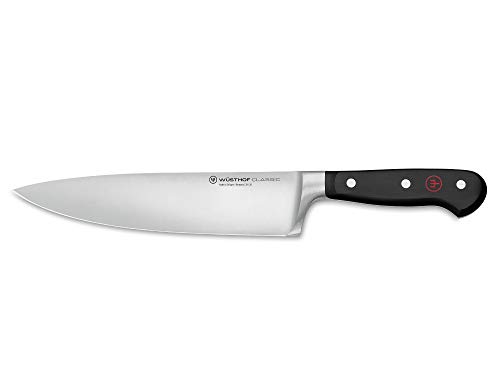
2. Best for a durable full bolster: WÜSTHOF Classic 8″ Chef’s Knife
Pros
- Forged from a single block of steel
- Full bolster and finger guard
- Fade-resistant synthetic handle
Cons
- The listing does not mention dishwasher safety
The WÜSTHOF Classic chef’s knife is forged from a single block of high carbon stainless steel. It features a full bolster and finger guard, a full tang, and a triple-riveted synthetic handle designed to resist fading. The listing mentions Precision Edge Technology for a sharper blade with extended edge retention.
Best for: Cooks who prefer a knife with a protective full bolster and a durable, fade-resistant synthetic handle.
3. Best matte finish blade: HOSHANHO Japanese High Carbon Steel 8″ Chef Knife

Pros
- Japanese high carbon steel blade
- Matte finish design
- Ergonomic wooden handle for pinch grip
Cons
- The listing does not mention care instructions
The HOSHANHO chef’s knife is made of Japanese high carbon steel (10Cr15CoMoV) with a matte finish. It features an ergonomic wooden handle with a sloped bolster designed to encourage a proper pinch grip. The listing states it is hand-sharpened to a 13-degree edge on each side.
Best for: Those looking for a knife with a modern matte blade finish and an ergonomic pinch-grip design.
4. Best full-tang knife: Amazon Basics Classic 8″ Chef’s Knife

Pros
- Full tang construction with three rivets
- Satin-finished, rust-resistant blade
- Semi-bolster for blade access
Cons
- The listing does not mention dishwasher safety
The Amazon Basics chef’s knife has a high carbon stainless steel blade with a satin finish that is stain, rust, and pit resistant. It features a full tang construction with three rivets and a semi-bolster design for weight, balance, and full blade access when sharpening.
Best for: Shoppers looking for a basic, full-tang chef’s knife with a semi-bolster for easy sharpening.
5. Best with an integrated blade and handle: PAUDIN 8 Inch High Carbon Stainless Steel Chef Knife

Pros
- High carbon stainless steel blade
- Integrated blade and wooden handle for balance
- Suitable for professional use
Cons
- The listing does not mention care instructions
The PAUDIN chef knife is made from high carbon stainless steel and is suitable for home and professional use. The listing emphasizes that the blade is integrated with a soft, comfortable wooden handle designed to provide the right balance and a perfect grip for the user.
Best for: Those who want a knife where the blade and handle are designed as one integrated, balanced unit.
6. Best with a specific bevel angle: KEEMAKE 8″ Chef Knife

Pros
- 1.4116 high carbon stainless steel
- Hand-sharpened 8–12 degree edge
- Pakkawood handle with sloped bolster
Cons
- The listing does not mention care instructions
The KEEMAKE chef knife is crafted from 1.4116 high carbon stainless steel with a hardness of 58±2 HRC. It is hand-sharpened to an 8–12 degree edge on each side. The handle is made of ultra-durable Pakkawood with a curved design and sloped bolster to promote a pinch grip.
Best for: Cooks interested in a knife with a specifically listed, narrow hand-sharpened bevel angle.
7. Best with a hammered finish and included sharpener: FACZER 8 Inch Chef Knife

Pros
- Hammered finish to reduce food sticking
- Includes knife holder and sharpener
- High carbon stainless steel blade
Cons
- The listing does not mention care instructions
The FACZER chef knife is forged from high carbon stainless steel with a 58±2 HRC hardness and a hammered blade texture to reduce friction. It is hand-honed to a 12-degree angle. The listing notes it comes with a knife holder and a knife sharpener, presented in a gift box.
Best for: Shoppers looking for a complete set with a hammered-finish knife and a maintenance sharpener included.
Japanese Handcrafted Chef Knives
Knives in this group emphasize precise, razor-sharp edges, often with Damascus cladding and specialized steel cores.
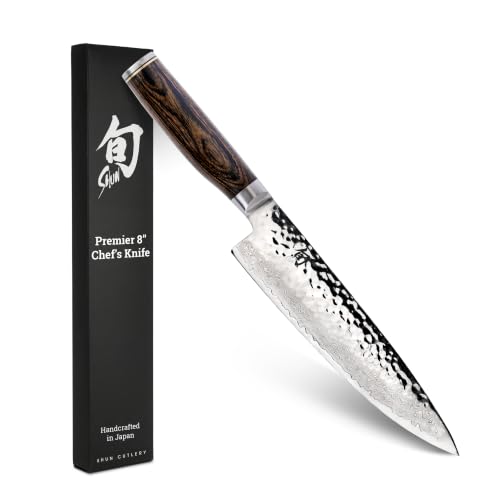
8. Best hammered finish for reduced drag: Shun Premier 8″ Chef’s Knife
Pros
- VG-MAX steel core with Damascus cladding
- Hammered finish to reduce food sticking
- Contoured Pakkawood handle
Cons
- Hand wash only (implied by care for similar knives)
The Shun Premier chef’s knife has a handcrafted Japanese design with a VG-MAX steel core and 68 layers of Damascus stainless steel cladding. It features a distinctive hammered tsuchime finish which the listing says reduces drag and prevents food from sticking. The contoured Pakkawood handle is designed for a secure grip.
Best for: Those who want a visually striking Japanese knife with a food-release hammered finish.
9. Best classic Japanese design: Shun Classic 8″ Chef’s Knife

Pros
- Original Shun Classic Series design
- VG-MAX steel with Damascus cladding
- D-shaped Pakkawood handle for ambidextrous use
Cons
- The listing does not specify care instructions
The Shun Classic chef’s knife is part of the original Japanese cutlery line introduced to the US. It has a VG-MAX steel core with 68 layers of Damascus cladding and a 16-degree edge. The handle is a D-shaped Pakkawood design intended to offer a secure grip for both left and right-handed users.
Best for: Cooks interested in the original, authentic Japanese cutlery series with a distinctive D-shaped handle.
10. Best with a VG-10 core and resin wood handle: Atumuryou Japanese Chef Knife 8 Inch (VG10)

Pros
- VG-10 steel core with Damascus cladding
- Hand-sharpened 12-degree edge
- Stabilized wood and resin handle
Cons
- The listing does not mention care instructions
This Atumuryou chef knife features a VG-10 steel core with 67-layer Damascus cladding and a Rockwell hardness of 62 HRC. It is hand-sharpened to a 12-degree edge and has an ergonomic handle made from stabilized wood and resin for a slip-resistant grip. It comes with a gift box.
Best for: Cooks seeking a knife with a high-hardness VG-10 core and a unique, grippy resin wood handle.
11. Best with a distal taper and octagonal handle: KAWAHIRO 8.27 Inch Japanese Chef Knife (VG10)

Pros
- VG10 steel core with 3-layer construction
- Distal taper for precise cutting
- Octagonal wood handle
Cons
- The listing does not mention care instructions
The KAWAHIRO chef knife is hand-forged with a VG10 steel core and 3-layer construction, hardened to 60+ HRC. It features a refined distal taper (thinner towards the tip) and is traditionally hand-sharpened. The handle is a balanced octagonal wood design, and it comes in a wooden gift box.
Best for: Enthusiasts who appreciate traditional Japanese details like a distal taper and an octagonal wooden handle.
12. Best hand-forged Damascus with a leather sheath: Atumuryou 8 Inch Japanese Chef Knife (Damascus)

Pros
- Hand-forged VG10 Damascus steel
- 67-layer Damascus construction
- Includes leather sheath and gift box
Cons
- The listing does not mention care instructions
This Atumuryou chef knife is hand-forged with a Japanese VG10 Damascus steel core and 67-layer Damascus construction. It has a hand-sharpened 12-degree edge and a kurouchi finish. The handle is made from unique stabilized wood and resin, and it includes a leather sheath and premium gift box.
Best for: Those seeking a hand-forged Damascus knife presented with a leather sheath for storage or gifting.
13. Best kiritsuke (hybrid) style knife: SANMEIHO 9 Inch Kiritsuke Chef Knife

Pros
- 10Cr15MoV high carbon steel, 62 HRC
- Kiritsuke (hybrid) blade style
- Octagonal G10 and rosewood handle
Cons
- The listing does not mention care instructions
The SANMEIHO kiritsuke chef knife is a 9-inch blade crafted from premium 10Cr15MoV high carbon steel with a 9-layer structure and 62 HRC hardness. It features a 12-degree razor edge and a hand-forged, textured finish. The handle is an octagonal blend of G10 and rosewood.
Best for: Advanced cooks interested in the versatile kiritsuke style, which combines features of a chef’s knife and a slicer.
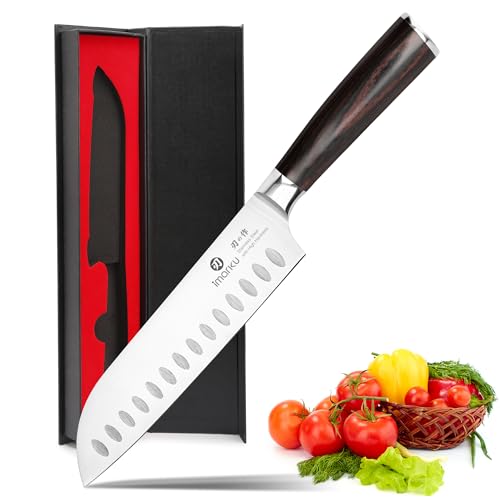
14. Best santoku with a hollow edge: imarku Santoku Knife 7 Inch
Pros
- Japanese high carbon stainless steel
- Hollow edge design to reduce sticking
- Advanced Pakkawood handle for comfort
Cons
- The listing does not mention care instructions
The imarku Santoku knife is a 7-inch blade made of Japanese high carbon stainless steel. It features a hollow edge (scalloped) design which the listing says keeps food from sticking to the blade. The handle is made from advanced Pakkawood and is designed to minimize wrist tension.
Best for: Cooks who prefer a versatile santoku knife with a hollow edge to prevent food from sticking.
15. Best triple-layer laminated steel blade: HOSHANHO 7 Inch Japanese Santoku Knife

Pros
- Triple-layer laminated steel blade
- Frosted design and 15-degree edge
- African pakkawood handle
Cons
- The listing does not mention care instructions
This HOSHANHO Santoku knife features a blade forged with triple-layer laminated steel made from Japanese 10Cr15CoMoV steel. It has a frosted design and is hand-sharpened to a 15-degree angle. The handle is made from African pakkawood, designed for comfort and control.
Best for: Those interested in the durability and performance of a triple-layer laminated steel construction.
Professional & Culinary School Knives
Designed for heavy use, these models often highlight ergonomic handles and high-carbon steel for easy maintenance.
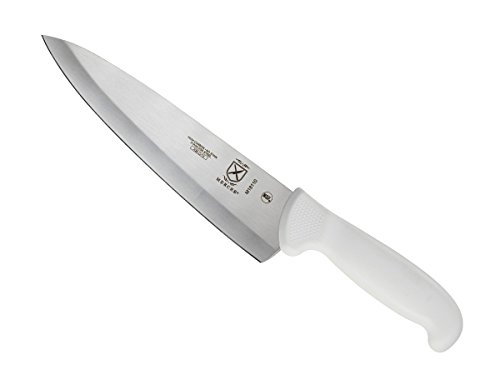
16. Best lightweight option: Mercer Culinary Ultimate White 8″ Chef’s Knife
Pros
- Lightweight design
- High-carbon Japanese steel blade
- Textured, non-slip handle
Cons
- Hand wash only
The Mercer Culinary Ultimate White chef’s knife is made with high-carbon Japanese steel for a razor-sharp blade. It features an ergonomic handle with textured finger points for a non-slip grip. The listing states it is ideal for chopping, mincing, and dicing tasks and requires hand washing.
Best for: Those who want a very lightweight chef’s knife with a secure grip for everyday prep.
17. Best with a shortened bolster for sharpening: Mercer Culinary Renaissance 8-Inch Chef’s Knife

Pros
- Shortened bolster for easier sharpening
- Triple-riveted Delrin handle
- Suitable for professional use
Cons
- The listing does not mention dishwasher safety
The Mercer Culinary Renaissance chef’s knife is noted as great for culinary students and professionals. It features a shortened bolster that the listing says makes sharpening easier by exposing the full blade. The handle is triple-riveted Delrin with an ergonomic design.
Best for: Users who frequently sharpen their own knives and want full blade access.
18. Best longer blade for large tasks: Mercer Culinary Ultimate White 10″ Chef’s Knife

Pros
- Longer 10-inch blade
- High-carbon Japanese steel
- Textured, non-slip handle
Cons
- Hand wash only
This is a 10-inch version of the Mercer Culinary Ultimate White chef’s knife. It is crafted from high-carbon Japanese steel and has the same ergonomic handle with textured finger points for a non-slip grip. The listing recommends hand washing for care.
Best for: Cooks who regularly work with large ingredients like roasts or big bunches of herbs and need more blade length.
19. Best with a Pakka handle for reduced fatigue: imarku Japanese Chef Knife 8 Inch

Pros
- High-carbon stainless steel blade
- Ergonomic Pakkawood handle to reduce fatigue
- Multipurpose gyutou design
Cons
- The listing does not specify care instructions
The imarku chef knife is made from high-carbon stainless steel and is designed as a multipurpose gyutou knife. It features an ergonomic Pakkawood handle intended to minimize fatigue and finger numbness during extended use. The listing mentions it has an ultra-sharp edge for tough tasks.
Best for: Home cooks and professionals who spend long periods prepping and want a comfortable, fatigue-reducing handle.
20. Best nakiri (vegetable cleaver) style: Sunnecko Nakiri Knife 7″

Pros
- Nakiri (vegetable cleaver) design
- 12-degree double-bevel edge
- Includes a sheath for storage
Cons
- The listing does not mention care instructions
The Sunnecko nakiri knife is a 7-inch multipurpose cleaver designed for vegetables, fruits, and boneless meat. It is made from Japanese high-carbon stainless steel and hand-polished to a 12-degree double-bevel edge. The listing states it comes with a sheath and is gift-ready.
Best for: Vegetable-focused cooks who want a dedicated nakiri knife for chopping and slicing produce.
21. Best textured grip for safety: Mercer Culinary Millennia 8-Inch Chef’s Knife
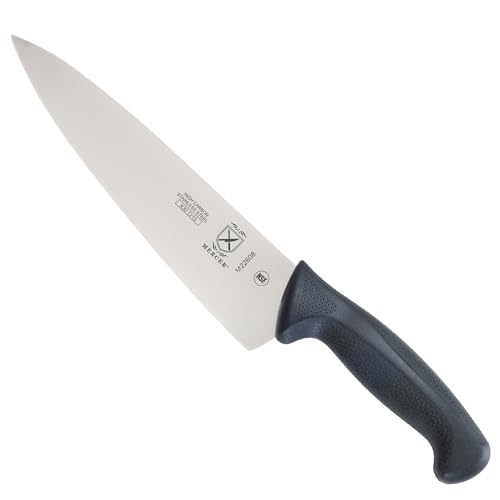
Pros
- One-piece high-carbon Japanese steel
- Ergonomic handle with textured finger points
- Explicit hand-wash care instructions
Cons
- Hand wash only
The Mercer Culinary Millennia chef’s knife is crafted from one-piece high-carbon Japanese steel. It has an ergonomic handle with textured finger points designed for a non-slip grip, added comfort, and safety. The listing specifies hand washing only to maintain the knife’s performance.
Best for: Culinary students or home cooks who prioritize a secure, non-slip grip and easy blade maintenance.
How to choose the best chef knives
Selecting a chef knife is a personal decision that hinges on how it feels in your hand and suits your cutting style. The best chef knives balance sharpness, comfort, and durability. Start by considering the blade: German-style forged knives are typically heavier and feature a curved blade for a rocking chop, while Japanese-style knives are often lighter, harder, and have a straighter edge for precise push-cutting. The handle material—whether synthetic, Pakkawood, or natural wood—affects grip and maintenance. Always check the manufacturer’s care instructions, as many high-quality knives require hand washing and proper storage to maintain their edge.
What to look for
- Blade Construction: Forged knives are made from a single piece of steel, often offering more heft and balance. Stamped knives are cut from a sheet of steel and can be lighter. Check the listing for terms like “fully forged” or “high-carbon steel.”
- Handle Ergonomics: Look for mentions of a “full tang” (where the steel runs the length of the handle), “triple-riveted” for durability, and “ergonomic” or “pinch grip” design for comfort and control during long prep sessions.
- Edge & Sharpness: Listings may note the edge angle (e.g., 16-degree, 12-degree) or technology (e.g., “Precision Edge”). A narrower angle can mean a sharper edge but may require more careful use. Descriptions like “razor-sharp” or “hand-sharpened” indicate the factory edge quality.
- Intended Use: Some knives are labeled as “all-purpose” or “multipurpose,” while others like santoku or nakiri are designed for specific tasks. Choose based on the majority of your kitchen tasks.
Remember, the sharpest knife is the safest knife when used correctly. Keep your knife sharp with appropriate tools and always use a proper cutting board. For more details on knife types and care, read our Chef’s Knife Buying Guide and guide to choosing a cutting board.
FAQ
What’s the difference between a German and a Japanese chef knife?
German-style chef knives, like those from HENCKELS and WÜSTHOF, typically have a heavier, thicker blade with a more pronounced curve, suited for a rocking chopping motion. They are often made from slightly softer steel that is durable and easier to sharpen. Japanese-style chef knives, like those from Shun, often have a thinner, harder blade with a straighter edge, designed for precise slicing and push-cutting. They may use harder steels like VG-MAX or VG10, which can hold a sharper edge longer but may be more brittle.
How often should I sharpen my chef knife?
The frequency depends on how often you use the knife, what you cut, and your board material. A knife used daily may benefit from honing with a steel before each use to realign the edge, and professional sharpening 1-2 times per year. Signs it needs sharpening include difficulty slicing through tomatoes or paper, or the blade tearing food instead of cutting cleanly. Always follow the sharpening method recommended for your knife’s specific steel and edge angle.
Can I put my chef knife in the dishwasher?
Most manufacturers of quality chef knives recommend hand washing. As seen in listings for Mercer Culinary knives, they specify hand washing with warm water and mild soap, then drying completely. Dishwasher detergents can be abrasive, high heat can damage handles (especially wood), and knocking against other utensils can chip the fine edge. For longevity and safety, hand washing is the best practice.
What does “full tang” mean?
A full tang means the blade’s steel extends the full length and width of the knife’s handle. It is visible as a metal spine sandwiched between the handle scales and is often secured with rivets. This construction generally provides better balance, durability, and control. Many forged German knives and some Japanese-style knives feature a full tang, which is often mentioned in the product features.
References
- Amazon product listings and manufacturer specifications (accessed October 2026)
- FDA Food Safety Guidelines
- NFPA Cooking Safety